Xieyi Painting and the Use of "Splash Ink"
|
"Splash Ink," or pōmò (潑墨), is a bold and expressive technique in Xieyi painting that involves applying ink in a free and spontaneous manner, often using a loaded brush to create large, sweeping washes. The goal is to capture a sense of movement and dynamism. It is a technique that prioritizes spontaneity and the uninhibited application of ink. 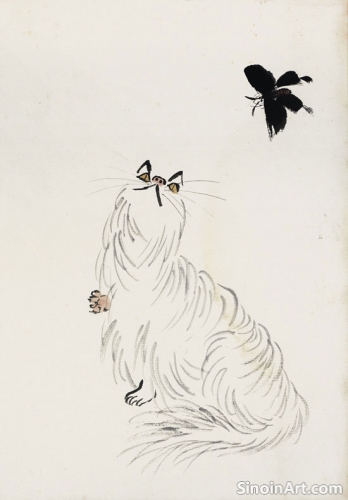 This technique often involves using the ink without precise control, allowing the ink to spread and blend naturally on the paper, resulting in unpredictable and expressive forms. The ink interacts with the paper in a way that highlights its fluid nature. It is a technique that values embracing the unexpected.  "Splash ink" is particularly effective for depicting landscapes, clouds, water, or other natural scenes where movement and fluidity are key elements. The effects are natural and highly organic. The results can be dynamic, atmospheric, and expressive of a wide range of emotions.  The application of splash ink requires both confidence and a good understanding of the ink's behavior. The artist must learn how to load the brush, how much pressure to apply, and how much water to use in order to achieve the desired effect. It is a technique that appears spontaneous, but also requires technical mastery. While pōmò may seem haphazard, it is often carefully planned and executed, with the artist strategically using the technique to achieve balance, depth, and a sense of vitality. It is the intentional use of spontaneity. It is about embracing the creative potential of the unexpected. |
Tag : Splash ink technique, Pomo, spontaneous ink, dynamic washes, Xieyi method
Related information
- Xieyi Painting and the Depiction of Birds
- The Influence of Chan (Zen) Buddhism on Xieyi
- The Role of the Inkstone in Xieyi
- The Influence of Folk Art on Xieyi Painting
- Xieyi Painting and the Concept of "Ziran"
Birds are frequently depicted in Xieyi painting through fluid brushstrokes that capture their form, movement, and energy, with symbolic meanings adding depth and emphasizing freedom, spontaneity, and the beauty of nature, while also showing the artist's technical skill and observation of the world.
Chan (Zen) Buddhism profoundly influences Xieyi painting, emphasizing intuition, direct experience, mindfulness, and the concept of emptiness, aligning with the art form's focus on spontaneity, self-expression, and the pursuit of truth through art.
The inkstone (yàn) is a vital part of Xieyi painting, influencing the quality and texture of ink, and serving as an object of both practical use and beauty, representing a key part of the ritual of painting and connecting the artist to tradition.
Xieyi painting is also influenced by Chinese folk art, through its emphasis on boldness, simplicity, vibrant colors, directness, and storytelling, enriching the art form with expressive forms, a more accessible feel, and narratives that connect it to everyday life, history, and folklore.
"Ziran" (naturalness) is a cornerstone of Xieyi painting, emphasizing effortless ease, rejection of artificiality, and a profound connection with the natural world, requiring an understanding of materials and authenticity in personal expression, allowing the art process to unfold organically.