Xieyi Painting and the Use of "Leaving the Brush"
|
The technique of "Leaving the Brush," or cángfēng (藏鋒), is an important element in Xieyi brushwork, referring to the way the artist begins and ends a stroke, concealing the tip of the brush to create lines that are both strong and subtle. It's a technique that adds a quality of depth and intentionality to the artwork. The technique represents a deliberate and subtle handling of the brush. 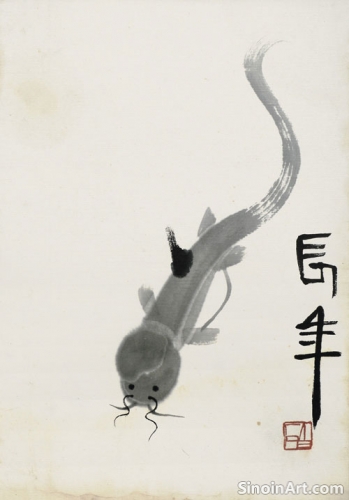 In cángfēng, the artist begins a stroke by drawing the brush into the paper, starting with the side rather than the point, and then ending the stroke by lifting the brush with a smooth, controlled motion. The stroke is not abruptly stopped; it has a feeling of continuation and a smooth transition. 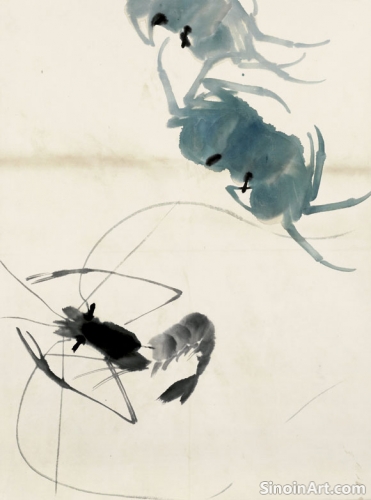 This technique creates lines that have a subtle beginning and end, a quality that conveys inner strength, control, and intentionality. The feeling of power is not aggressive, but more like a calm, deep, flowing stream. It creates a feeling of subtlety and a power that is under control. 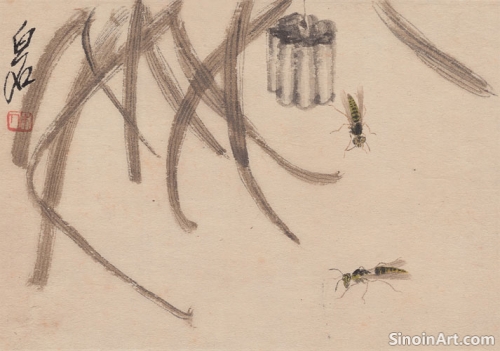 The use of cángfēng is often contrasted with "revealing the brush" (lùfēng), where the tip of the brush is clearly visible at the beginning or end of the stroke. Cángfēng aims for a feeling of subtlety and control, while lùfēng is a more overt and direct application of ink. Mastering the "Leaving the Brush" technique is essential for creating brushwork that is both powerful and refined, demonstrating a deep understanding of brush control and the principles of Xieyi. The subtle nuances in the strokes make a considerable difference to the overall feel and flow of the artwork. It is a key part of the skill of the artist. |
Tag : leaving the brush, concealed brush, Xieyi lines, subtle technique
Related information
- The Essence of Expression: An Introduction to Xieyi Painting
- Xieyi Painting as a Form of Personal Expression
- Xieyi Painting and the Use of "Boneless Technique" ( Mògǔ)
- The Spiritual and Philosophical Dimensions of Xieyi
- Materials and Tools for Xieyi Painting
This article introduces Xieyi painting, a freehand and expressive style of Chinese painting, emphasizing its focus on capturing the essence of a subject through bold brushwork and simplified forms.
Xieyi painting is a deeply personal form of expression, allowing artists to share their inner world, interpret their subject matter freely, and create unique artworks that reflect their individual vision, emotions, and experiences, making it a vehicle for both artistic expression and self-discovery.
The "Boneless Technique" (mògǔ) in Xieyi relies on the absence of outlines, instead using washes of ink and color to create form and texture, resulting in fluid, organic works that require skill in blending and layering, as well as spatial awareness.
Xieyi painting is deeply rooted in Chinese philosophy, particularly Daoism and Chan Buddhism, emphasizing the importance of spontaneity, mindfulness, the pursuit of qi or vital energy, and the spiritual significance of emptiness in art.
The four treasures of the study - brushes, ink, paper, and inkstone – are crucial tools for Xieyi painting. Each tool, from brush construction to paper absorbency, affects the ink application and contributes to the unique character of the artwork.