Gongbi and Xieyi: Two Sides of the Brush
|
Gongbi and Xieyi are often presented as the two major styles of traditional Chinese painting, representing two contrasting approaches to artistic expression. While Gongbi emphasizes meticulous detail, precise brushstrokes, and realistic representation, Xieyi, often referred to as "freehand" or "literati" painting, emphasizes expressive brushwork, spontaneous composition, and capturing the essence of the subject rather than its literal appearance. These two styles reflect distinct artistic philosophies and techniques.  The core difference between Gongbi and Xieyi lies in their approach to capturing reality. Gongbi artists seek to depict the world with as much accuracy and detail as possible, using fine lines and carefully applied colors to create a realistic representation. In contrast, Xieyi artists focus on capturing the spirit or essence of the subject with more gestural brushstrokes and simplified forms. The aim is not to recreate a perfect image but to express the artist's emotional response to the subject. 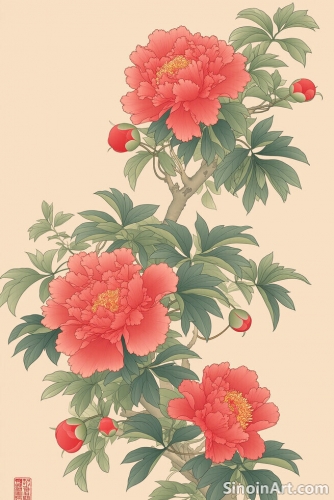 The techniques employed in each style also differ significantly. Gongbi relies on precise outlines (gougou) and meticulous layering of colors (ranse), demanding a high degree of control and patience. Xieyi, on the other hand, favors spontaneous brushstrokes, varying ink washes, and a more expressive approach. Xieyi brushwork emphasizes variation in pressure and ink density to create a sense of energy and movement within the painting.  The subject matter often associated with each style also reflects their different intentions. Gongbi paintings often feature detailed depictions of flowers, birds, historical scenes, and human figures, emphasizing precision and clarity. Xieyi, on the other hand, often focuses on more abstract subjects such as bamboo, plum blossoms, and landscapes, emphasizing the underlying essence and the artist's emotional response. While there can be overlap, the main differences in subject preferences reflect the art form's distinct goals. Gongbi and Xieyi, though contrasting, are both essential components of the rich tradition of Chinese painting. They represent different but equally valuable approaches to artistic expression, each with its own set of techniques and aesthetic goals. Understanding the differences between these two styles is key to appreciating the diversity and depth of Chinese art. Both offer unique insights into the Chinese cultural landscape and artistic tradition. |
Tag : Gongbi vs Xieyi, Chinese painting styles, meticulous painting, freehand painting, literati painting
Related information
- Gongbi vs. Xieyi: Contrasting Styles in Chinese Art
- Gongbi Painting and Storytelling: Narrative Through Detail
- Gongbi Painting and its Use in Book Illustration
- Symbolism in Gongbi Painting: Reading the Language of Detail
- The Use of Borders and Mountings in Gongbi Painting
A comparison of Gongbi and Xieyi painting styles, highlighting their contrasting techniques, philosophies, and artistic intentions.
Explores the narrative power of Gongbi painting, highlighting its ability to tell stories through detail, symbolism, and historical or mythological depictions.
This article explores the use of Gongbi painting in book illustration, highlighting its ability to bring narratives to life through detailed depictions, accurate representations, and vibrant colors, and how this enhances the reader's understanding and appreciation of the text.
Gongbi painting is not only a visual art but also a rich tapestry of symbolic meanings, where the careful selection and rendering of subjects, colors, and compositional elements serve to convey specific messages and cultural values. The meticulous detail, characteristic of the style, enhances the symbolic weight of each object, transforming a seemingly realistic depiction into a complex visual language. This symbolic richness adds layers of meaning to the artistry of Gongbi painting.
This article explores the role of borders and mountings in Gongbi painting, highlighting their function as framing devices, visual balancers, and how their specific styles and materials contribute to the overall aesthetic and cultural significance of the artwork.