Bronze Ware and the Ancient Chinese Understanding of Material Science: Alloys, Properties, and Applications
|
The creation of Chinese bronze ware required a sophisticated understanding of material science, and the ancient metalworkers had a deep knowledge of different alloys, their properties, and their specific applications, demonstrating their expertise in both artistic design and scientific knowledge. The development of bronze required both careful observation and also extensive practical experience in the metalworking arts.  The selection and mixing of different metals, particularly copper, tin, and lead, to create bronze alloys with specific properties, required precise control of temperature, timing, and the ratio of materials, demonstrating their advanced knowledge of metallurgy. The use of different alloys helped to influence both the durability and also the tone of musical instruments. The understanding of these different properties allowed for a greater flexibility in design and application.  The understanding of bronze as a stable and durable material, capable of being cast into complex shapes and decorated with intricate patterns, also helped to guide its use in a variety of applications. The understanding of bronze's unique properties helped to ensure its place as a central material in ancient China. 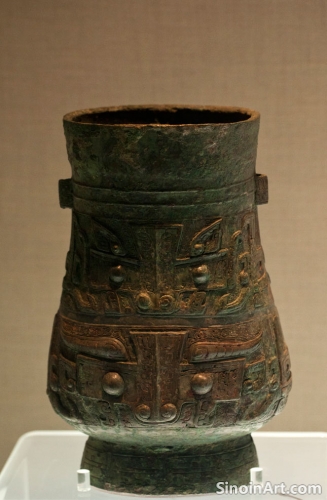 The study of ancient Chinese bronze ware reveals an underlying scientific curiosity and an approach to material experimentation that is truly remarkable. The knowledge that they possessed allowed them to transform the natural world into powerful and beautiful artistic creations. The integration of science and art is a key element in ancient Chinese culture. |
Tag : bronze material science, Chinese alloys, ancient metallurgy, metal properties, casting techniques
Related information
- The Future of Chinese Bronze Ware: New Discoveries, Research, and Interpretations
- Exploring Chinese Bronze Ware: A Guide for Beginners
- The Use of Bronze in Ancient Chinese Ritual Practice: Beyond Vessels and Symbols
- The Influence of Ancient Chinese Bronze Ware on Later Japanese Art and Design
- The Use of Bronze in Ancient Chinese Maritime Activities: Vessels and Tools
This article explores the future of Chinese bronze ware studies, highlighting the potential for new discoveries, the use of advanced scientific techniques, new theoretical approaches, and how ongoing research will continue to enrich our understanding of these remarkable artifacts.
This article provides a guide for beginners to the study of Chinese bronze ware, outlining key periods, types of objects, common motifs, and providing a roadmap for a deeper exploration of this fascinating art form.
This article explores the use of bronze beyond vessels and weapons in ancient Chinese ritual practices, highlighting bronze musical instruments, ritual implements, and ceremonial objects, and revealing how these objects played a crucial role in spiritual ceremonies.
This article explores the influence of ancient Chinese bronze ware on later Japanese art and design, highlighting the adoption of Chinese forms and techniques, the development of unique Japanese styles, and the impact of cultural exchange on creative expression.
This article explores the use of bronze in ancient Chinese maritime activities, highlighting its role in ship construction, the creation of navigational and fishing tools, and its contribution to the development of trade and exploration.