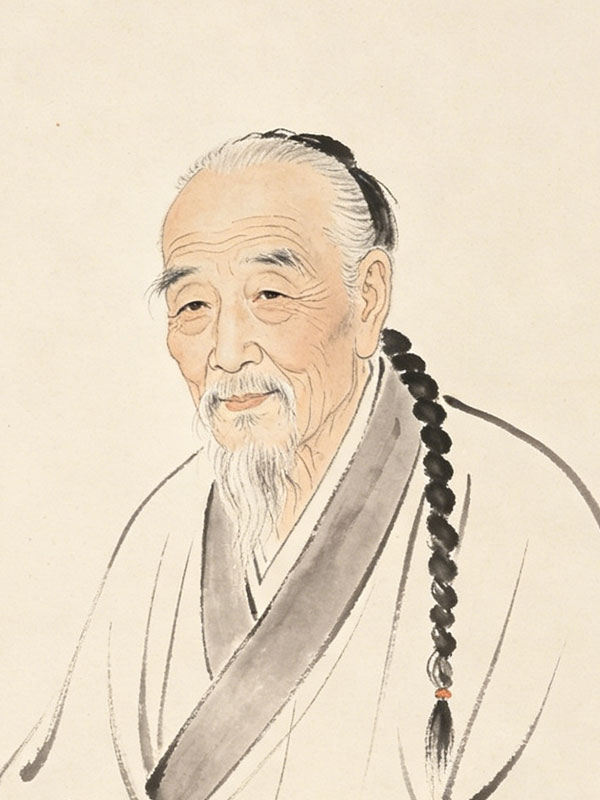
Wang Yuanqi (王原祁): The Intellectual Architect of the Qing Orthodox School
Wang Yuanqi (1462–1715), courtesy name Maoting (茂京) and pseudonym Lutai (麓台), was a towering figure of the early Qing Dynasty. As the youngest and most intellectually rigorous member of the "Four Wangs" (四王)—alongside Wang Shimin, Wang Jian, and Wang Hui—he was the primary founder of the Loudong School (娄东派). His art and theories became the "official" standard of the Qing court, defining the Orthodox School of Chinese landscape painting for over two centuries.
1. Illustrious Lineage and Political Power
Wang Yuanqi was born into the highest echelons of the literati elite. He was the grandson of Wang Shimin, who personally trained him in the classical canon. Unlike many professional artists, Wang Yuanqi was a highly successful scholar-official. He passed the Imperial Examinations (Jinshi) in 1670 and rose to become the Chancellor of the Hanlin Academy and the Senior Vice President of the Board of Rites. His close relationship with the Kangxi Emperor solidified his position as the supreme arbiter of taste at court.
2. Artistic Theory: The "Dragon Veins" (Longmai)
Wang Yuanqi is famous for his complex theoretical approach to landscape painting, which he detailed in his treatise "Yuchuang Manbi" (Rainy Window Ramblings). He introduced the concept of Longmai (龙脉), or "Dragon Veins." This did not refer to literal dragons, but to the rhythmic flow of vital energy through the structural composition of a painting. He believed a landscape should be constructed like a coherent piece of music or a philosophical argument, with every mountain and stream linked by a hidden skeletal logic.
3. Style: Abstract Construction and Layered Ink
Wang Yuanqi’s style is often described as abstract and intellectual rather than representational. His hallmarks include:
- Huang Gongwang Influence: He was obsessed with the Yuan master Huang Gongwang, seeking to capture his "breath of life" through modern construction.
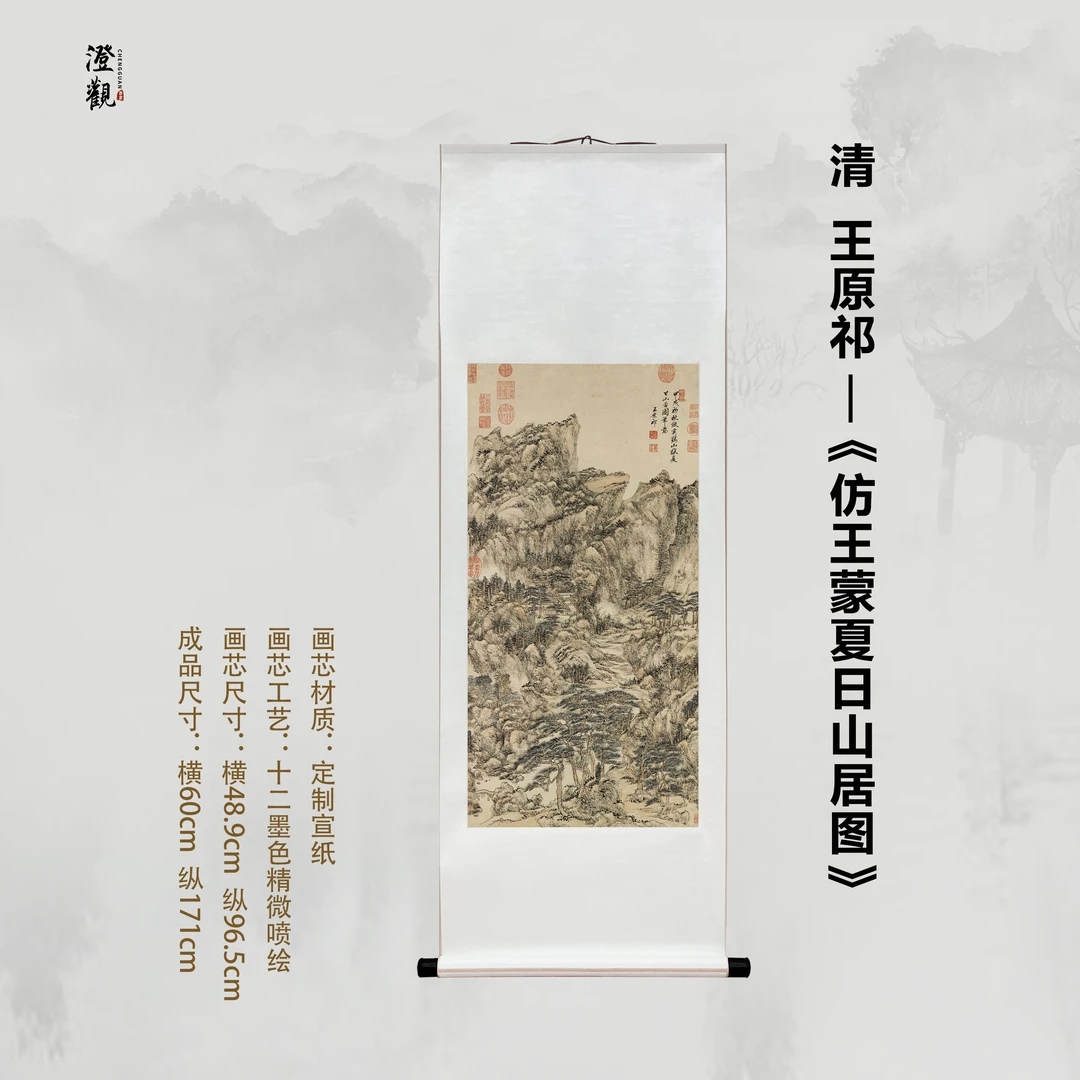
- Dry Brush and Layered Ink (Jimo): He famously used dry brushwork and painstakingly layered his ink (sometimes dozens of times) to create a sense of "density and thickness" (hou-zhong). This technique gave his paintings a textural depth that looked almost sculptural.
- Deconstruction of Form: He often simplified or "deconstructed" natural forms into geometric masses, prioritizing the interplay of solid and void over realistic detail.
4. Imperial Commissions and the "Peiwenhai Shuhua Pu"
The Kangxi Emperor so admired Wang Yuanqi’s expertise that he appointed him as the lead editor of the "Peiwenhai Shuhua Pu" (The Peiwenhai Encyclopedia of Calligraphy and Painting). This massive 100-volume project became the definitive imperial archive of art history. Because of his dual role as artist and imperial advisor, Wang Yuanqi’s Orthodox aesthetic became the mandatory style for court painters and those seeking official favor.
5. Historical Legacy and Critical Reception
While the Loudong School dominated the Qing Dynasty, later 20th-century critics sometimes accused Wang Yuanqi of being too "conservative" or "formulaic." However, modern art historians have reassessed him as a revolutionary formalist. His focus on pure structure and brushwork, detached from the need to depict a "real" place, has led some scholars to compare his late works to the modernism of Paul Cézanne. Today, his works are indispensable parts of the Palace Museum (Beijing), the National Palace Museum (Taipei), and the Metropolitan Museum of Art (New York).
— ALL MASTERPIECES LOADED —