
Gong Xian, the most prominent figure of the Eight Masters of Nanjing, created Leisurely Fishing in Mountain Dwelling (Shan Ju Xian Diao Tu) as a profound meditation on spiritual seclusion. This masterpiece encapsulates the artist's transition into a world of "ink and silence" after the fall of the Ming Dynasty. Unlike the light, airy styles of his predecessors, Gong’s work in this scroll presents a landscape of density, where the natural world feels both physically heavy and spiritually transcendent, reflecting the loyalist (Yimin) identity of a scholar-official in hiding.
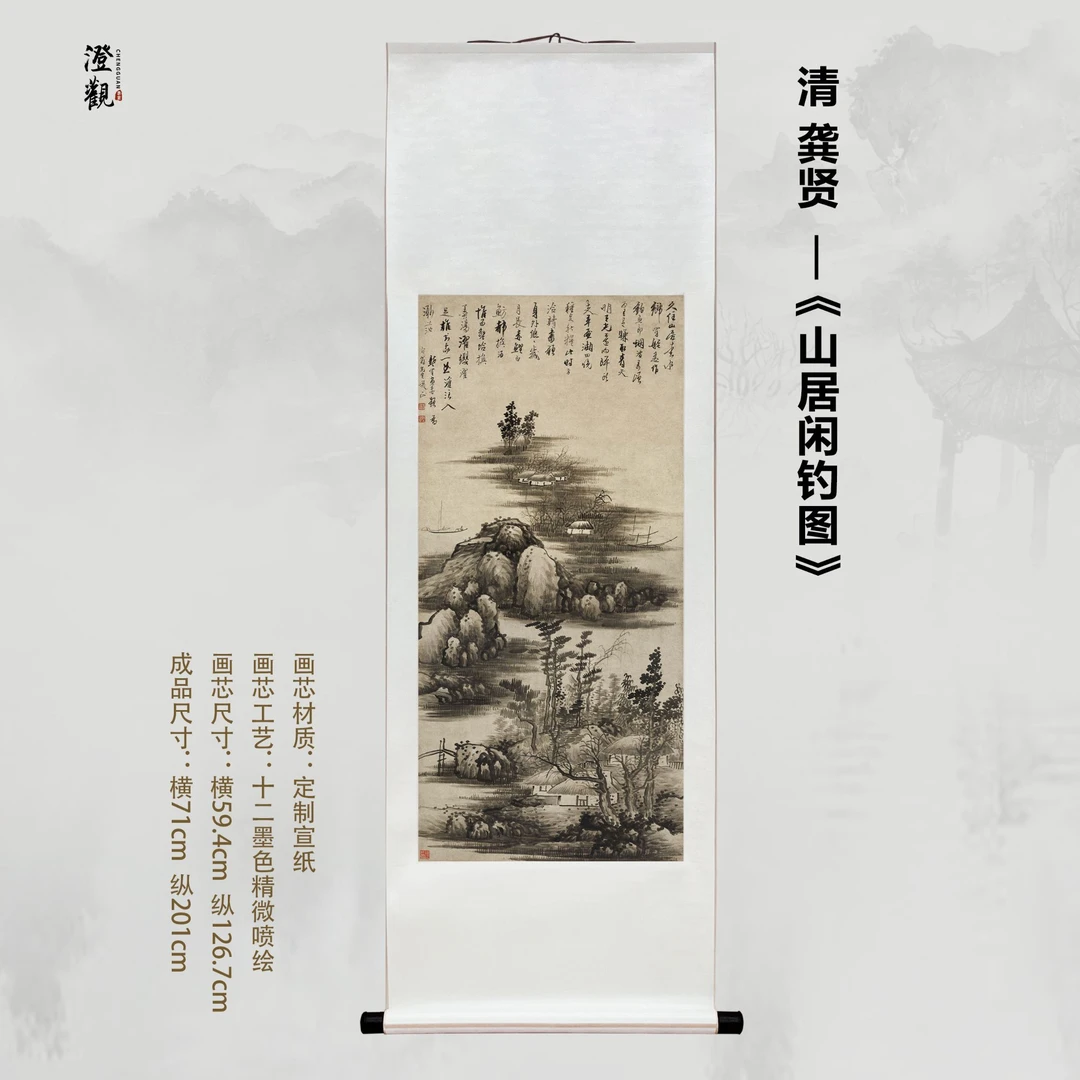
The defining characteristic of this painting is Gong Xian’s unparalleled use of the "accumulated ink" (jimo) technique. By applying dozens of layers of ink—ranging from dry brushstrokes to moist washes—he achieves a tactile richness that was revolutionary for his time. This "Black Gong" style gives the jagged cliffs and ancient trees a monumental volume and a moist, atmospheric quality. The deep shadows created by this layering process do not merely represent light; they represent a psychological depth, mirroring the somber internal state of the artist.
In terms of spatial composition, the painting artfully balances the "solid" and the "void." While the mountains are rendered with oppressive density, the areas representing water and sky are left nearly blank, creating a haunting contrast. The motif of the solitary fisherman in the boat serves as the visual and emotional anchor of the work. This figure is not merely a decorative element but a classic literati symbol of the "hermit-scholar" who seeks refuge from the political turmoil of the Ming-Qing transition within the eternal rhythms of nature.
The textural strokes (cun) used in Leisurely Fishing in Mountain Dwelling are meticulously organized, showing Gong's unique geometric precision. He often used small, dense dots (dian) to build up the moss-covered surfaces of rocks, creating a vibrating energy that makes the landscape seem to breathe. This rhythmic repetition of dots and lines lends the work a proto-modernist quality, as it focuses more on the abstract structural integrity of the ink than on a literal imitation of nature.
Furthermore, the painting serves as a philosophical bridge between traditional Chinese aesthetics and a more subjective, individualistic expression. Gong Xian moved away from the "elegant" beauty of the Southern School to embrace a forbidding, majestic landscape that demands silence and introspection from the viewer. His influence on later artists, particularly modern master Huang Binhong, is immense, as he proved that darkness and density could be used to express the most luminous aspects of the human spirit.
Ultimately, Leisurely Fishing in Mountain Dwelling remains one of the most significant examples of seventeenth-century ink wash art. Its combination of formal innovation and emotional sincerity continues to captivate scholars and collectors worldwide. By preserving a sense of unyielding integrity through his brushwork, Gong Xian transformed a simple scene of fishing into a timeless monument of intellectual resistance and artistic excellence.