
Ding Guanpeng (active 1726–1771), a highly esteemed court painter during the reign of the Qianlong Emperor, created Ruibin Riyong (蕤宾日永) as a vibrant celebration of the Dragon Boat Festival (Duanwu). The title "Ruibin" refers to the musical pitch associated with the fifth lunar month, while "Riyong" signifies the "everlasting sun" or long days around the Summer Solstice. This painting is a premier example of the Qing court academy style, designed to showcase the harmony and cultural richness of the imperial household.
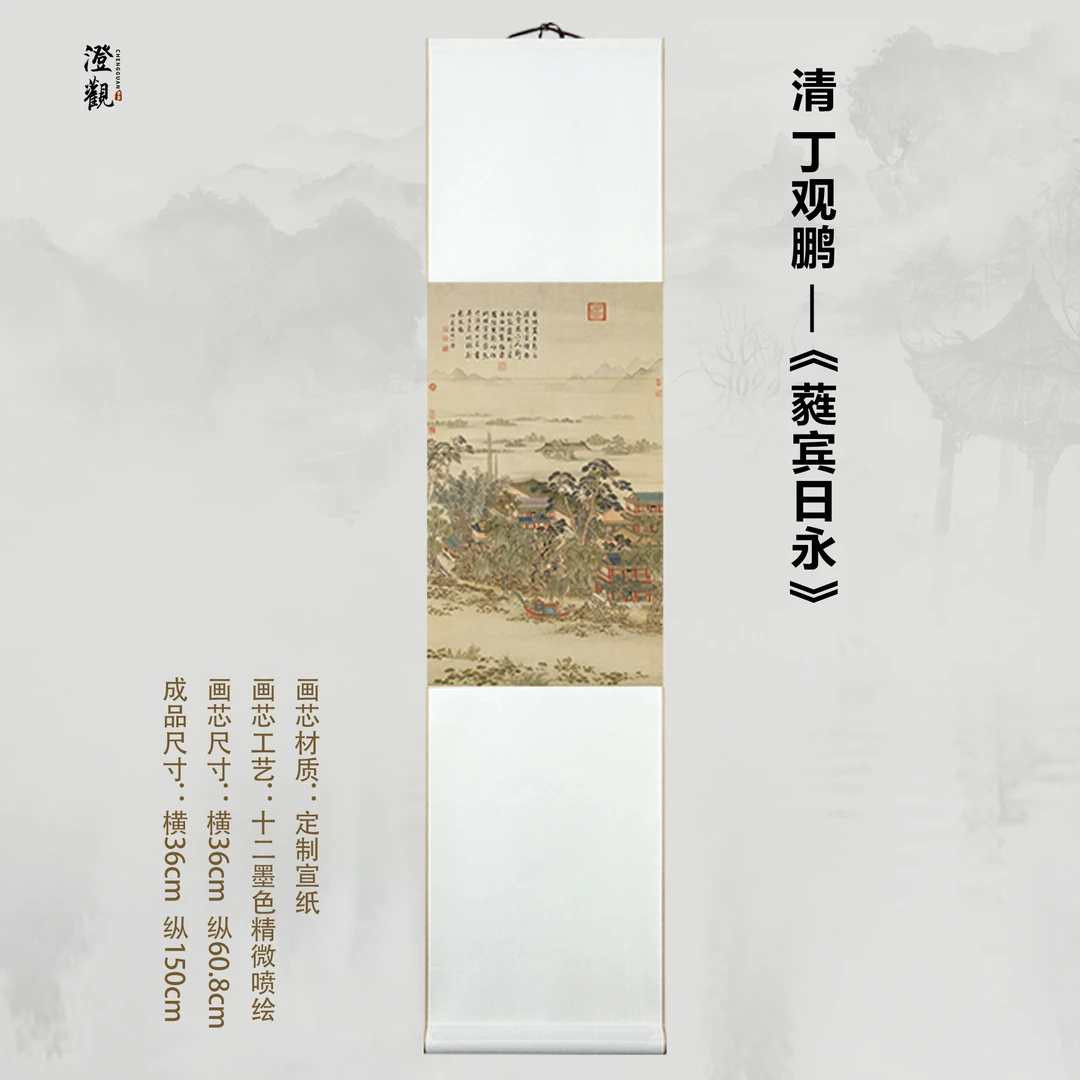
One of the most striking features of this work is the sophisticated fusion of East and West. Having studied under the Jesuit missionary Giuseppe Castiglione (Lang Shining), Ding Guanpeng integrated Western linear perspective and subtle chiaroscuro (light and shadow) into traditional Chinese gongbi (meticulous) brushwork. This results in figures and architectural elements that possess a three-dimensional realism rarely seen in earlier Chinese painting, making the palace scenes appear remarkably lifelike and immersive.
The painting provides an intimate look into the imperial garden lifestyle. It depicts elegant palace ladies and spirited children engaged in festive traditions, such as gathering medicinal herbs and hanging calamus and mugwort to ward off evil spirits. The lush greenery and blooming flowers are rendered with botanical precision, reflecting the "auspicious atmosphere" (ruiqi) that the Qianlong Emperor sought to document as a testament to his prosperous reign and the stability of the empire.
Architecturally, Ruibin Riyong showcases the jiehua (ruled-line painting) technique with extraordinary skill. The ornate pavilions and corridors, likely modeled after the Yuanmingyuan (Old Summer Palace), are drawn with mathematical accuracy. The intricate patterns on the windows and the textures of the stone balustrades highlight the opulence of the Qing court, serving not just as a backdrop but as a symbol of the order and refinement of the Manchu dynasty’s peak.
Beyond its aesthetic beauty, the painting carries profound symbolic meaning. It belongs to the category of "Festive Paintings" (Sijie Tu), which were produced to celebrate the lunar calendar cycles. By capturing the joy and rituals of the fifth month, Ding Guanpeng emphasizes the concept of "Peace and Prosperity" (Tianxia Taiping). The work functions as a visual prayer for the continued longevity of the Emperor and the perpetual flourishing of the Qing state.
Today, Ruibin Riyong is preserved as a treasure of 18th-century Chinese art. It remains a vital resource for scholars studying Qing dynasty costume, palace architecture, and the historical evolution of Sino-Western artistic exchange. Ding Guanpeng’s ability to maintain classical Chinese elegance while embracing global technical innovations ensures that this work remains a cornerstone of the imperial art legacy.