
The National Palace Museum in Taipei houses one of the most magnificent examples of 18th-century court painting: Ding Guanpeng’s "Spring Morning in the Han Palace" (仿仇英漢宮春曉圖). Created in 1748 during the peak of the Qing Dynasty, this handscroll is not merely a reproduction but a sophisticated re-imagining of the Ming Dynasty masterpiece by Qiu Ying. Commissioned by the Qianlong Emperor, the work stands as a testament to the monarch’s obsession with classical art and his desire to showcase the opulence of his own reign through a historical lens.
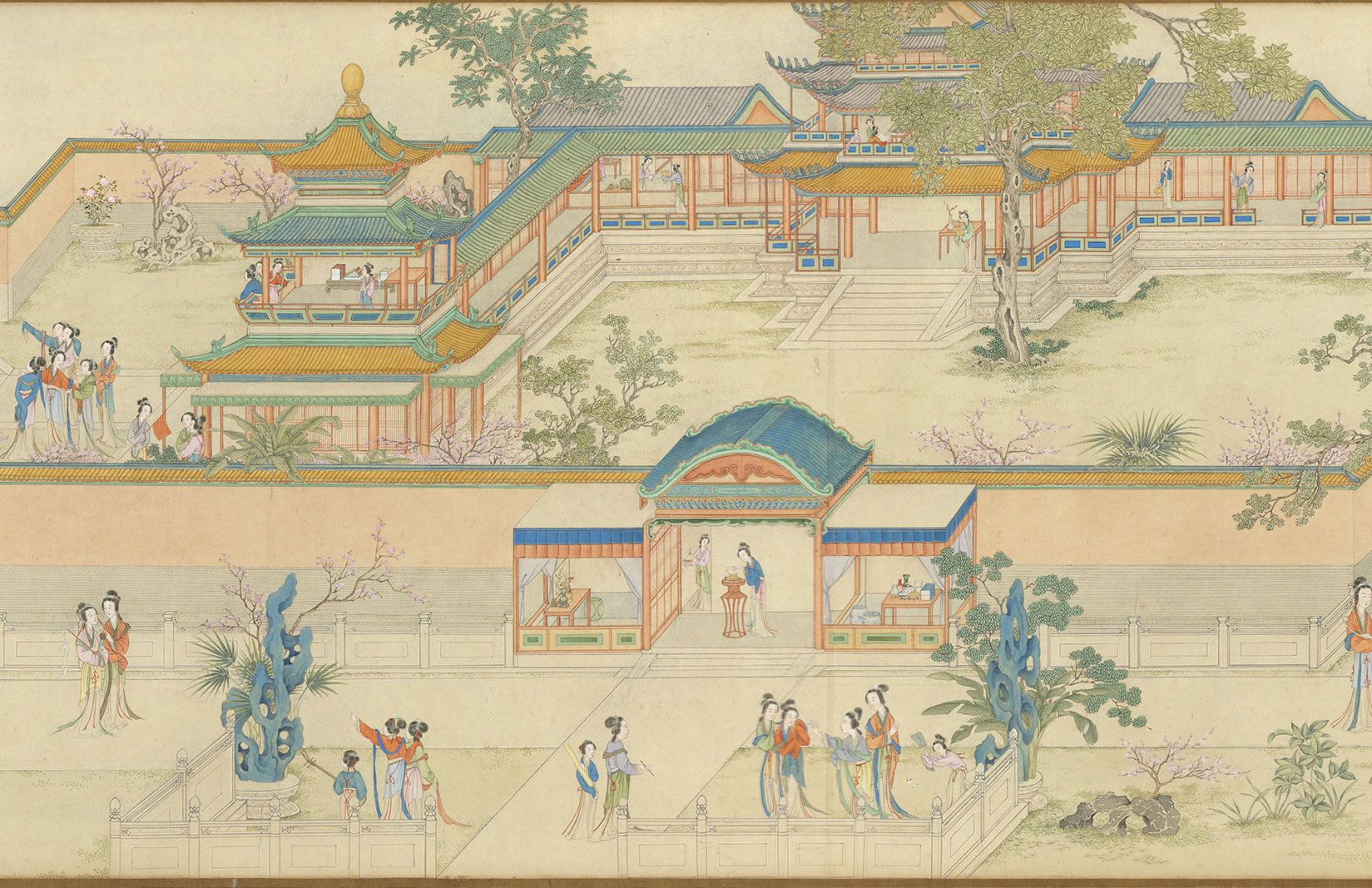
The artist, Ding Guanpeng, was a preeminent court painter who thrived under the influence of the "Western-style" painting trend introduced by Jesuit missionaries like Giuseppe Castiglione (Lang Shining). Unlike the original Ming version, Ding’s rendition is a masterclass in the fusion of styles. While it retains the traditional Chinese Gongbi (meticulous brushwork) technique, it integrates linear perspective and chiaroscuro (light and shadow modeling). This gives the architectural structures a structural depth and the figures a three-dimensional realism that was revolutionary for its time in Chinese art.
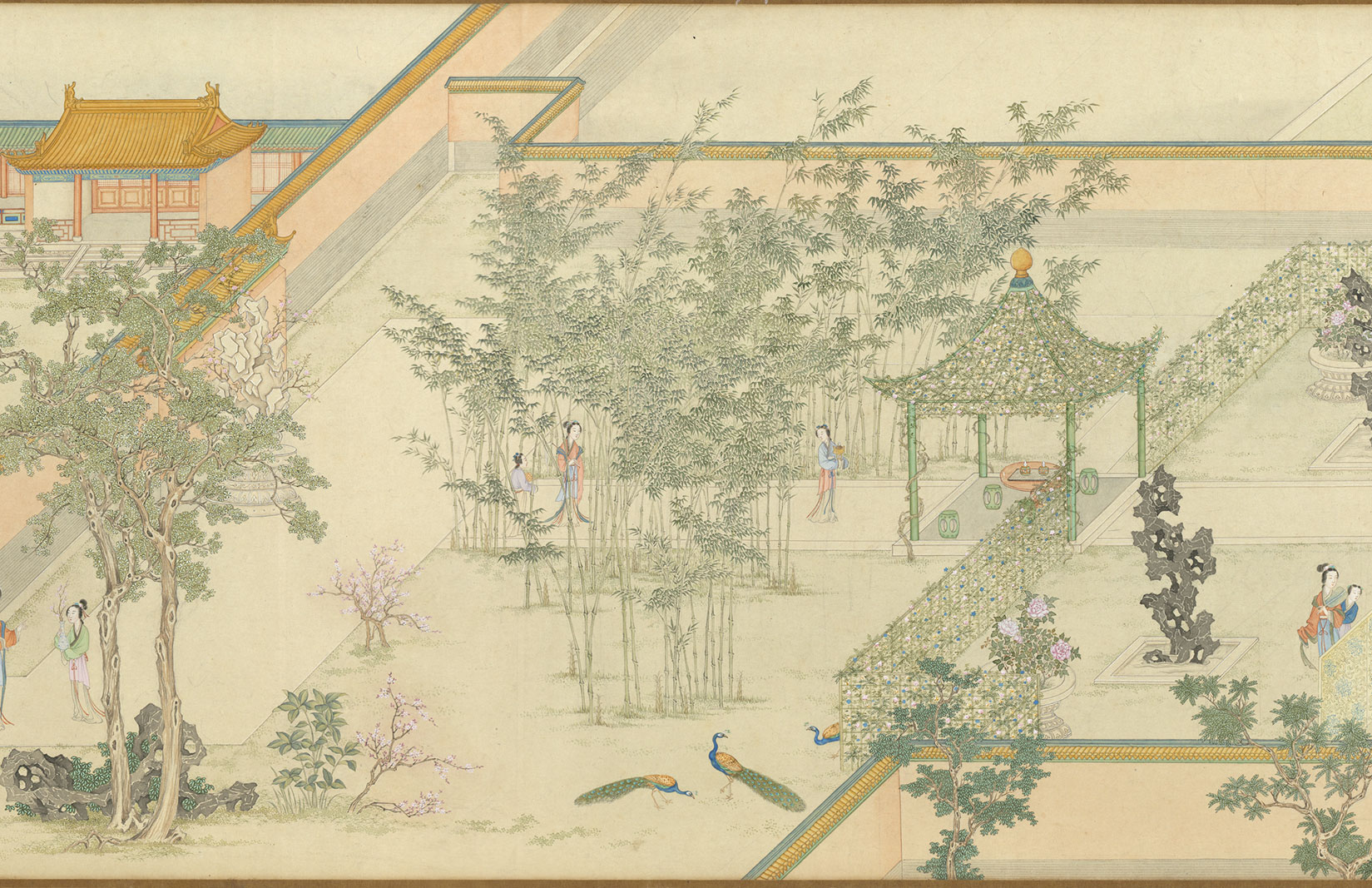
Visually, the scroll is an explosion of color and detail. Utilizing expensive mineral pigments such as malachite green, azurite blue, and cinnabar, the colors remain vibrantly alive centuries later. The narrative unfolds through a series of "leisurely" scenes within a stylized Han-era palace: court ladies playing chess, practicing music, tending to children, and grooming themselves. A pivotal moment in the scroll is the depiction of the artist Mao Yanshou painting the portrait of Wang Zhaojun, a classic historical motif that Ding renders with exquisite architectural precision using jiehua (boundary painting) techniques.
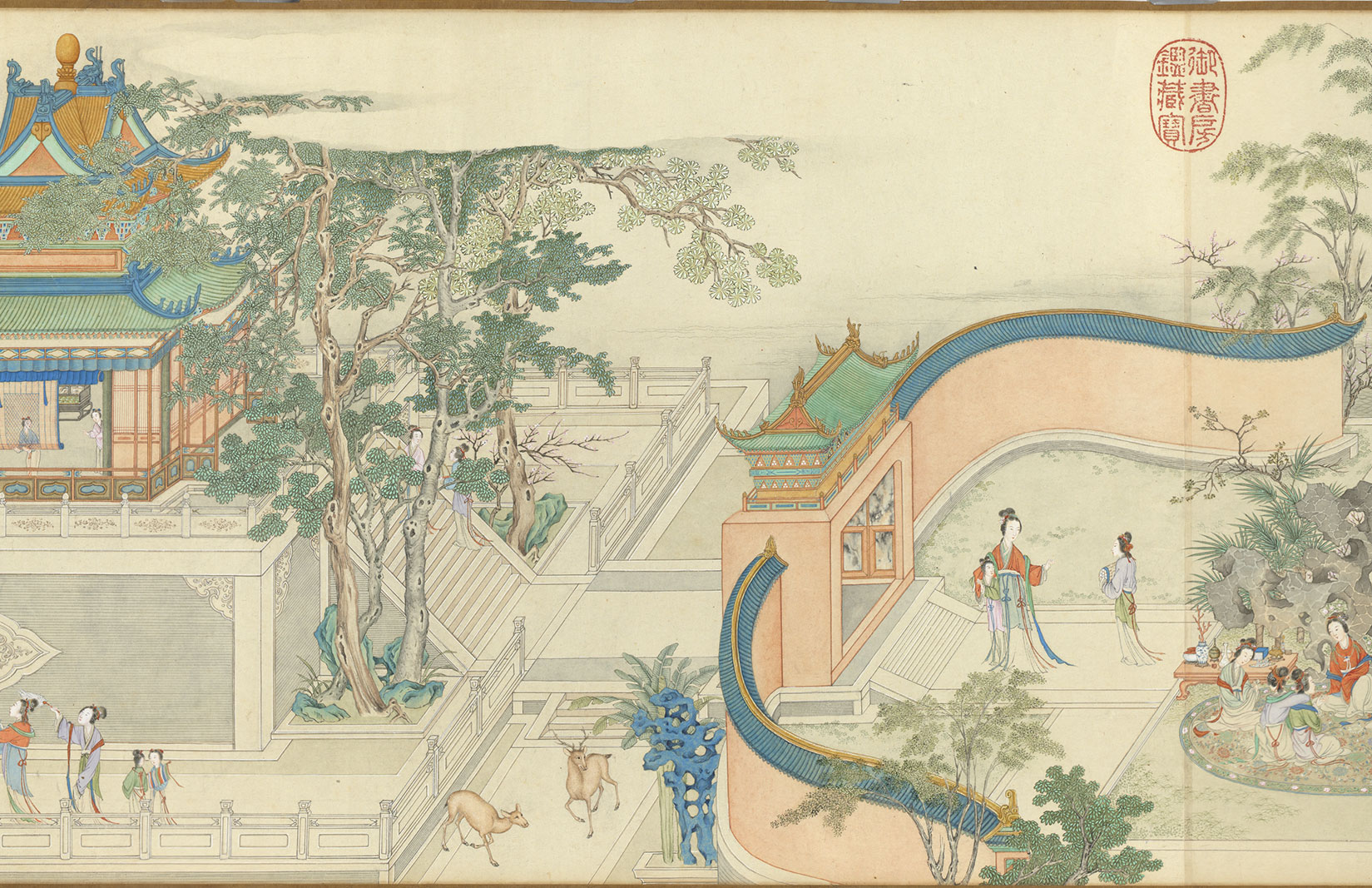
The spatial arrangement in Ding Guanpeng’s version significantly differs from Qiu Ying’s. While Qiu Ying utilized a more lyrical, ethereal "blank space" approach typical of the Ming literati, Ding employed geometric perspective to create a grand, orderly, and majestic atmosphere. The corridors and courtyards recede into the distance with mathematical accuracy, reflecting the Qianlong Emperor’s vision of a world that was both culturally rich and strictly ordered under his imperial rule.
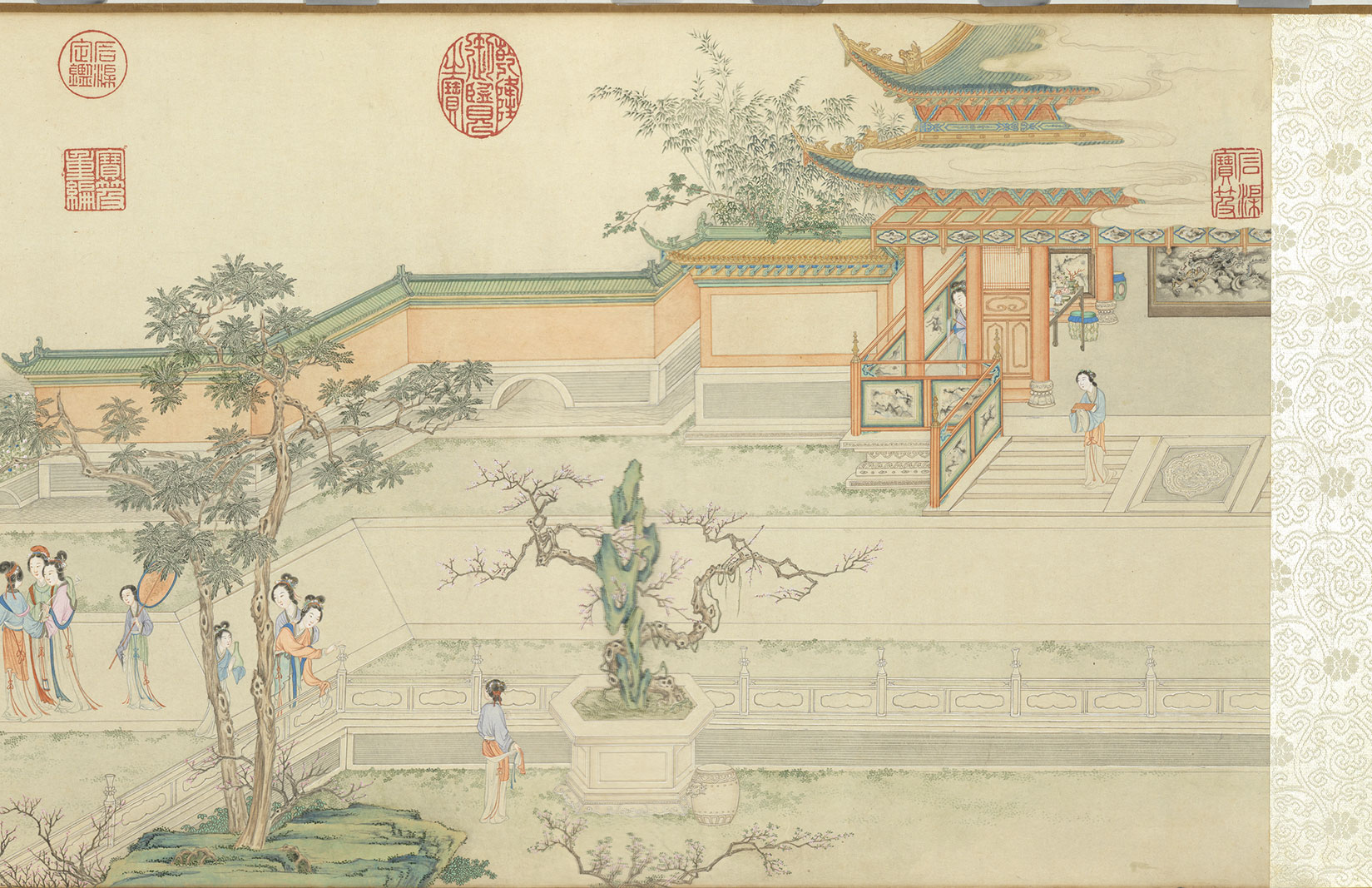
In conclusion, Ding Guanpeng’s "Spring Morning in the Han Palace" is more than a tribute to Qiu Ying; it is a masterpiece that defines the Prosperous Era of Qianlong. It represents a unique historical moment where Eastern aesthetics and Western scientific observation met on silk. For art historians and collectors, this scroll remains a vital document of Chinoiserie and the evolution of Chinese imperial painting, preserving a dream of the Han Dynasty filtered through the grandeur of the Qing.